Author: Hamilton

Supreme Court Decision: Nationstar v. Stafsholt (Attorney Fees)

On March 23, the Supreme Court issued a unanimous decision in Nationstar Mortgage v. Robert R. Stafsholt. The court held that circuit courts, acting in equity, have the power to award attorney fees to prevailing parties. In this case, the court held that the defendant was entitled to attorney fees but was not exempt from paying interest on a loan during the time of litigation.

In this case, Robert and Colleen Stafsholt obtained a mortgage that required them to maintain insurance on their home. The bank (Bank of America, at the time – the mortgage eventually changed hands to Nationstar) sent a letter to the Stafsholts informing them it would purchase and charge them for lender placed insurance (LPI) if they did not provide proof of homeowner’s insurance. The Stafsholts sent proof of insurance but continued to receive charges for LPI on their mortgage account.

When Stafsholt called the bank to get the charge removed, the bank representative told him he should skip a mortgage payment and become delinquent in order to reach the next level of customer service. Stafsholt followed the representative’s instructions but never reached the next level of customer service. Instead, the bank accelerated his mortgage, continued to charge LPI, ignored Stafsholt’s offers to reinstate the loan, and eventually filed a foreclosure action against Stafsholt.

The issue before the Supreme Court was whether Stafsholt could recover attorney fees and whether the bank could recover interest accrued during the time of litigation.

The Supreme Court held that circuit courts do have the power to award attorney fees in equitable actions in exceptional cases. The court ruled this an “exceptional” case because the bank intentionally caused the dispute and its “conduct was an attempt to use Wisconsin courts to extort the LPI charges from Stafsholt.”

However, the court also held that the bank could still collect interest accrued during litigation because Stafsholt would “receive a windfall” if he was exempt from interest and received attorney fees.
Legislature Passes Common Sense Civil Litigation Reforms

In their March 22 extraordinary session, the Wisconsin Assembly concurred in AB 773, which contains a number of important civil litigation reforms, including discovery and class action rules. The bill now heads to Gov. Scott Walker for his signature.

AB 773 is a major victory for Wisconsin businesses and will significantly reduce the cost of litigation. Common-sense reforms under the bill will:

  • Prevent litigants from abusing the discovery process to leverage a higher potential settlement or engage in a “fishing expedition.”
  • Allow parties to appeal a trial court’s decision to certify a class in a class action lawsuit.
  • Lower the statute of limitations for a number of claims.
  • Prohibit the Department of Revenue from entering into a contract that includes contingency fee audits for any company domiciled in the state or that maintains its principal place of business in the state. Working under contingency fee arrangements incentivizes aggressive approaches to audits that unfairly increase costs for businesses in Wisconsin.
  • Require notice of third-party litigation financing. Such third-party finance can increase the cost of litigation and cause suits to be brought that would not otherwise have been financially justified. Wisconsin will become one of the first states in the nation to require mandatory disclosure of third party litigation financing.

“AB 773 is a major victory for small to large Wisconsin businesses and will greatly reduce the cost of litigation. The legislation brings Wisconsin in line with the vast majority of other states when it comes to its discovery procedures and class action rules. WCJC thanks the bill authors, Sens. Tom Tiffany and Dave Craig, along with Reps. Mark Born and John Nygren,” said Bill G. Smith, president of the Wisconsin Civil Justice Council and state director for National Federation of Independent Business-Wisconsin.

Floor Report: Senate and Assembly Wrap Up Priority Issues of 2017-18 Session

The Senate and Assembly met this week for what is likely the last floor votes of the 2017-18 session. Although the Assembly had said they were finished in February, Senate changes to priority issues led the Assembly to meet in extraordinary session on Thursday. In the extraordinary session, the Assembly passed gun safety legislation outside of what passed the Senate, and it is unclear whether the Senate will return to take up the controversial bill.


Senate Session

The Senate session on March 20 began with a several-hour delay while the Republican Senate and Assembly caucuses finalized compromises on several key issues including juvenile justice reform, the child tax rebate and sales tax holiday, and school safety.

On the child tax rebate and sales tax holiday, the Senate passed its own bill (SB 798) that narrowed the Assembly’s version, but still included the $100 per child credit and a one-time, two-day sales tax holiday the first weekend in August of 2018. The sales tax holiday exempts from sales taxes purchases of 1) clothing priced up to $75, 2) personal computers priced up to $750, 3) school computer supplies priced up to $250, and 4) school supplies priced up to $75.

Despite initial reluctance from the Republican Senate caucus, the Senate ultimately decided to pass a version of the juvenile justice bill (AB 953) restoring much of the legislation passed by the Assembly. The Senate plan closes Lincoln Hills, establishes a new facility for the more serious offenders, and includes the county run model for secured residential care centers for children and youth. The bill includes a study committee to make recommendations throughout the process.

On school safety, the Senate passed a substitute amendment to a bill already on the calendar (AB 843). The Senate’s plan mirrors most of Gov. Scott Walker’s proposal, including establishing an Office of School Safety in the Department of Justice and funding $100 million in school safety grants. The Senate version does not allow school safety officers as an eligible expense under the grant program and removes the privacy exemption in Walker’s plan for law enforcement access to school surveillance footage.

The Senate also passed an amended version of AB 773, a bill that would lower litigation costs for businesses by modernizing Wisconsin’s civil procedures for discovery and class actions. The Senate amendment to the bill, which first passed the Assembly on a bipartisan voice vote, would eliminate the provisions limiting discovery of electronically stored information.

The Senate also concurred in a long list of bills that now await Walker’s signature.

On AB 259, which updates the Wisconsin tax code to certain provisions in the Internal Revenue Code, Sen. Janis Ringhand (D-Evansville) introduced an amendment related to property tax assessments based on comparable sales, or what municipalities are calling the “dark store loophole.” While leadership ruled the amendment not germane, Senate Majority Leader Scott Fitzgerald (R-Juneau) said there would be an upcoming legislative study committee on the issue. The Senate then concurred in AB 259, as amended by the Assembly.

Other notable bills that will be signed into law include: occupation credential fee waivers for low-income individuals and veterans, apprenticeship participation for high schoolers, a $6.8 million talent attraction initiative, and this session’s two opioid abuse treatment and prevention bills.


Assembly Extraordinary Session

In the extraordinary session on Thursday, March 22, the Assembly took up and passed a short list of bills that had been amended by the Senate on Tuesday. The following bills were concurred in and sent to Gov. Scott Walker for signature:

  • AB 953, the juvenile corrections bill.
  • AB 773, related to civil litigation reform.
  • SB 798, the child tax rebate and sales tax holiday.

The bulk of the Assembly session focused on gun control and school safety proposals. After lots of debate on both sides of the aisle, the Assembly passed the Senate version of the school safety proposal (AB 843). That bill, which contains the school safety measures proposed by Walker, now heads to his desk for signature.

However, the Assembly also passed a substitute amendment to one of the original school safety bills (AB 1031) that expands background checks, creates a school safety hotline, and changes victim compensation statutes. The Assembly also passed AB 1033, which allows a privacy exemption in for law enforcement access to school surveillance footage. The bill was part of Walker’s original school safety plan but was removed in the Senate proposal. It is still unclear whether the Senate will reconvene to take up AB 1031 and 1033.

WCJC Urges Wisconsin Senate to Pass AB 773

In their Feb. 22 session, the Assembly passed AB 773, which contains a number of important civil litigation reforms, including discovery and class action rules. The bill passed the Assembly on a voice vote and has been messaged to the Senate.

AB 773 aligns Wisconsin’s civil procedures for discovery and class actions to the corresponding federal rules. The modernization of these court procedures, mostly aimed at costly discovery practices, will reduce litigation costs for businesses, as well as state and local governments who must spend taxpayers’ dollars responding to abusive discovery practices.

Common-sense reforms under the bill will:

  • Prevent litigants from abusing the discovery process to leverage a higher potential settlement or engage in a “fishing expedition.”
  • Require notice of third-party litigation financing. Such third-party finance can increase the cost of litigation and cause suits to be brought that would not otherwise have been financially justified.
  • Limit discovery of electronically stored information (ESI) to address the escalating volume of ESI that is now one of the most significant discovery-related costs.
  • Allow parties to appeal a trial court’s decision to certify a class in a class action lawsuit.
  • Lower the statute of limitations for certain claims.
  • Prohibit the Department of Revenue from entering into contingency fee arrangements with third parties in unclaimed property audits. Working under contingency fee arrangements incentivizes aggressive approaches to audits that unfairly increase costs for businesses in Wisconsin.

The Substitute Amendment passed by the Assembly makes the following changes to the original bill, while keeping the rest of AB 773 intact:

  • Removes lawsuit lending.
  • Removes two of the class action provisions (“no-injury” class actions and “ascertainability”) but keeps the third provision allowing an interlocutory appeal of the trial court’s decision to certify a class.
  • Amends the five-year “lookback” provision by exempting medical records, vocational records, and educational records.
  • Amends language dealing with proportionality of discovery requests to directly mirror language contained in the federal rules.

Unfortunately, the legislation has met some resistance in the Wisconsin Senate. Specifically, Senator Van Wanggaard (R-Racine) has voiced his opposition to the legislation, going so far as to call the bill “unethical” in an interview with Wispolitics.com. Yet, as explained in a WCJC “Myths v. Facts” memo responding to the plaintiff attorneys’ arguments, AB 773’s language is a common-sense reform that does not give parties free rein to destroy evidence in a lawsuit.

WCJC is urging the Wisconsin Senate to take up and pass AB 773 when it returns for what is likely to be their last day in session on March 20.

The bill is supported by over 30 Wisconsin business organizations.

Update on State Supreme Court Race

After several months of campaigning for the state Supreme Court primary election, on Tuesday, Feb. 20, Wisconsin voters selected Sauk County Circuit Court Judge Michael Screnock and Milwaukee County Circuit Court Judge Rebecca Dallet to advance to the general election.

Screnock, who is considered the conservative in the race, received 46 percent of the vote. Dallet, a progressive, received 36 percent. Madison attorney and progressive Tim Burns received 18 percent of the vote and did not advance to the general.

While Screnock “won” the primary, it is unclear if he will have the numbers to win the general. Progressives Dallet and Burns altogether took 54 percent of the votes, so Screnock will need to convert some of the Burns votes or hope for higher conservative turnout in the general. Yet, with the typically low turnout for spring elections, many experts say anything can happen.

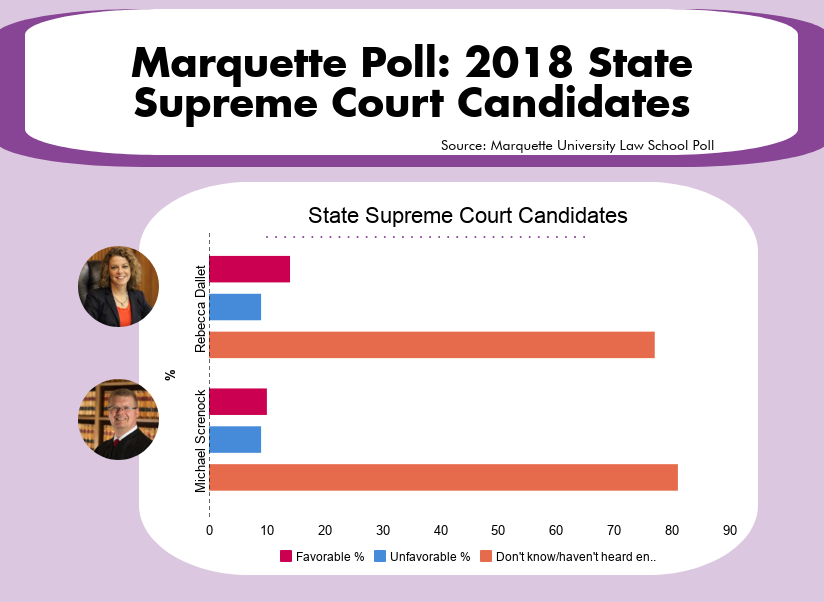
In the Marquette University Law School poll released on March 5, 14 percent of registered voters said they had a favorable opinion of Judge Rebecca Dallet. 10 percent had a favorable opinion of Judge Michael Screnock. However, most voters had not heard enough about the candidates to state an opinion.

Screnock and Dallet are participating in two debates before the April 30 election. On March 2, the candidates debated at Marquette University Law School, discussing issues including the role of justices, recusal rules, campaign contribution limits and the effects of donor influence, and the Act 10 ruling. Dallet touted her experience as a prosecutor and judge and said the court needs to move away from special interest groups that have gained too much influence. Screnock focused on his promise to uphold the rule of law and respect the state constitution and separation of powers doctrine. The next debate will be March 30.

Gov. Walker Signs Worker’s Compensation Fix

On Feb. 28, the governor signed SB 781 into law as Act 139. Act 139 prohibits an injured employee from filing an action in tort against third parties regardless of whether the employee makes a claim for compensation under the Worker’s Compensation Act against his or her employer.

The law reverses a  Wisconsin Court of Appeals, Dist. III decision (Ehr v. West Bend Mutual Ins. Co.) that significantly altered the Worker’s Compensation Act. The court ruled that the estate of a deceased employee could sue the employee’s temporary employer for an action in tort instead of filing a worker’s compensation claim under the Act. Specifically, the court ruled that the “exclusive remedy” provision under the Worker’s Compensation Act, “does not bar a temporary employee from bringing tort claims against his or her temporary employer.” The decision runs counter to how the Worker’s Compensation Act has been interpreted for many years. The exclusive remedy provision provides that an employee may only receive benefits from worker’s compensation for the injury. By ruling that the exclusive remedy did not apply in this case, the employee was able to sue his employer rather than submit a claim under worker’s compensation.


Signed by Governor: Leading on Lead Act, Wisconsin Health Care Stability Plan, and Worker’s Compensation Fix

In the last week, Gov. Scott Walker signed several major bills into law. On Wednesday, Feb. 21, in Milwaukee, the governor signed the Leading on Lead Act into law as Act 136. The Act allows water utilities to provide financial assistance to replace water laterals on private property containing lead. The law requires a municipal ordinance to be passed authorizing the financial assistance and Public Service Commission approval and provides various parameters for a grant or loan under the program. Act 136 will be a valuable tool for communities to utilize as part of the effort to eliminate lead pipes in Wisconsin. The Environmental Protection Agency estimates that at least 176,000 lead service lines connect homes to the municipal water mains.

On Tuesday, Feb. 27, the governor signed his Wisconsin Health Care Stability Plan into law as Act 138. The governor announced this plan a month ago in his State of the State address in order to keep premiums down and create more choices for consumers in Wisconsin.

Under Act 138, Wisconsin will establish a $200 million state-based reinsurance program. Implementation of the program requires the Office of the Commissioner of Insurance (OCI) to seek a 1332 waiver from the federal government. OCI has already begun working with a consultant to develop the waiver. It is expected the state will fund roughly 25 percent of the cost, with the federal government supporting the remaining 75 percent. For 2019 and depending on federal approval, OCI would set the payment parameters for the program so that the government would provide coinsurance payments for 50 to 80 percent of the cost for claims that are between $50,000 – $250,000.

In his press release, the governor stated that, “the reinsurance program is estimated to lower health care premiums for those in the individual market by 13 percent in 2019 and by 12 percent in 2020.”

Rounding out his week of major bill signings, on Feb. 28, the governor signed SB 781 into law as Act 139. Act 139 prohibits an injured employee from filing an action in tort against third parties regardless of whether the employee makes a claim for compensation under the Worker’s Compensation Act against his or her employer.

The law reverses a  Wisconsin Court of Appeals, Dist. III decision (Ehr v. West Bend Mutual Ins. Co.) that significantly altered the Worker’s Compensation Act. The court ruled that the estate of a deceased employee could sue the employee’s temporary employer for an action in tort instead of filing a worker’s compensation claim under the Act. Specifically, the court ruled that the “exclusive remedy” provision under the Worker’s Compensation Act, “does not bar a temporary employee from bringing tort claims against his or her temporary employer.” The decision runs counter to how the Worker’s Compensation Act has been interpreted for many years. The exclusive remedy provision provides that an employee may only receive benefits from worker’s compensation for the injury. By ruling that the exclusive remedy did not apply in this case, the employee was able to sue his employer rather than submit a claim under worker’s compensation.

Screnock, Dallet Move on To Wisconsin Supreme Court General Election

On Tuesday, Feb. 20, Wisconsin voters selected Sauk County Circuit Court Judge Michael Screnock and Milwaukee County Circuit Court Judge Rebecca Dallet to advance to the general election for Wisconsin Supreme Court.

Screnock, who is considered the conservative in the race, received 46 percent of the vote. Dallet, a progressive, received 36 percent. Madison attorney and progressive Tim Burns received 18 percent of the vote and did not advance to the general.

While Screnock “won” the primary, it is unclear if he will have the numbers to win the general. Progressives Dallet and Burns altogether took 54 percent of the votes, so Screnock will need to convert some of the Burns votes or hope for higher conservative turnout in the general. Yet, with the typically low turnout for spring elections, many experts say anything can happen.

Screnock and Dallet will participate in two debates on March 2 and March 30 before the general election on April 3.

WCJC Applauds Assembly for Passing Common Sense Civil Litigation Reforms

MADISON – The Wisconsin Civil Justice Council thanks the Wisconsin Assembly for passing Assembly Bill 773, which contains a number of important civil litigation reforms, including discovery and class action rules.

“These important litigation reforms will help reduce costs for small to large businesses and bring Wisconsin into the mainstream when it comes to discovery and class action lawsuits,” said Bill G. Smith, president of the Wisconsin Civil Justice Council and state director for National Federation of Independent Business-Wisconsin.

AB 773 aligns Wisconsin’s civil procedures for discovery and class actions to the corresponding federal rules. The modernization of these court procedures, mostly aimed at costly discovery practices, will reduce litigation costs for businesses, as well as state and local governments who must spend taxpayers’ dollars responding to abusive discovery practices.

Common-sense reforms under the bill will:

  • Prevent litigants from abusing the discovery process to leverage a higher potential settlement or engage in a “fishing expedition.”
  • Require notice of third-party litigation financing. Such third-party finance can increase the cost of litigation and cause suits to be brought that would not otherwise have been financially justified.
  • Limit discovery of electronically stored information (ESI) to address the escalating volume of ESI that is now one of the most significant discovery-related costs.
  • Allow parties to appeal a trial court’s decision to certify a class in a class action lawsuit.
  • Lower the statute of limitations for certain claims.
  • Prohibit the Department of Revenue from entering into contingency fee arrangements with third parties in unclaimed property audits. Working under contingency fee arrangements incentivizes aggressive approaches to audits that unfairly increase costs for businesses in Wisconsin.

The bill is supported by over 30 Wisconsin business organizations.

Wisconsin Supreme Court Primary Election Next Tuesday

Next Tuesday, voters will decide which two judicial candidates to the Supreme Court of Wisconsin will advance to the general primary held on April 3, 2018. The three candidates are Madison attorney Tim Burns, Milwaukee County Circuit Court Judge Rebecca Dallet, and Sauk County Circuit Court Judge Michael Screnock. The seat is currently held by Justice Michael Gableman, who is not seeking re-election.

Although Supreme Court races are officially nonpartisan, Burns and Dallet are seen as the two liberal candidates, while Screnock is considered the conservative. Because turnout for spring elections are typically very low, usually those who do show up to vote are partisans and very few swing voters. Because of that, some expect Dallet and Burns to be battling for the liberal votes, while most expect Screnock to get enough conservative votes to put him into the general election. Yet, with such a low turnout, many election experts say anything can happen, especially if the anti-Trump voters show up in full force next Tuesday.

Below are the campaign websites for all three candidates:

Tim Burns

Judge Rebecca Dallet

Judge Michael Screnock