Author: Hamilton

Following Wisconsin’s Lead, U.S. Senators Introduce TPLF Transparency Bill

Earlier this month, several U.S. Senators introduced a bill that would require disclosure of third party litigation financing in class action lawsuits. The introduction of the U.S. Senate bill comes after Wisconsin enacted groundbreaking reforms in Act 235 to require notice of third party litigation financing at the state level.

The Litigation Funding Transparency Act, by Sens. Chuck Grassley (R-Iowa), John Cornyn (R-Texas), and Thom Tillis (R-North Carolina), would require disclosure within 10 days of any agreements for commercial enterprises to receive payments contingent upon the monetary outcome of an action. The bill aims to provide transparency of such third party litigation financing arrangements that can increase the cost of litigation and cause suits to be brought that would not otherwise have been financially justified.

U.S. DOJ Announces New Policy to Reduce “Piling On”

In a speech to the New York City Bar on May 9, Deputy Attorney General Rod Rosenstein announced a new U.S. Department of Justice (DOJ) policy that encourages coordination within DOJ and between law enforcement agencies in parallel and/or joint proceedings in order to avoid duplicative penalties. The new policy aims to reduce the practice of “piling on,” or imposing multiple penalties for the same crime, which can lead to unfair settlements and uncertainty for businesses involved in investigations under the authority of multiple regulatory agencies.

The policy:

  1. Reinforces that DOJ attorneys should not use criminal enforcement authority as a threat to incentivize larger settlements.
  2. Directs DOJ attorneys to coordinate with one another in resolving cases with multiple department components to avoid duplicative and inequitable penalties.
  3. Similarly, directs DOJ to coordinate with other law enforcement agencies to avoid “piling on.”
  4. Directs DOJ to consider all relevant factors in coordinating multiple-component cases, taking into account, for example, the egregiousness of misconduct, statutory mandates, timeliness, and the company’s cooperation with the investigation.
  5. Stipulates that multiple penalties are appropriate in some circumstances, such as when penalties are designed for victim restitution.

In his speech, Rosenstein also highlighted several other recent DOJ policy changes, including ending third-party settlement payments to entities that are not harmed by a defendant’s conduct and prohibiting reliance on agency guidance documents.

Supreme Court Decision: Springer v. Nohl Electric Products Corporation (Successor Non-Liability)

On May 15, the Wisconsin Supreme Court held 5-2 in Springer v. Nohl Electric Products Corporation that the Wisconsin Uniform Fraudulent Transfer Act (WUFTA) does not govern the “fraudulent transaction” exception of successor non-liability. Traditionally, when a company buys another’s assets, it does not incur responsibility for liabilities attached to those assets. This rule exists to protect buyers from unexpected liability. However, certain exceptions apply, including if the transaction took place to fraudulently escape responsibility for the liabilities.

The case arose from an asbestos exposure lawsuit. Penny Springer sued multiple companies for her husband’s death from mesothelioma. Powers Holdings moved for summary judgment under the successor non-liability law because it was a successor to the previous business that dealt with asbestos-containing products. There was no evidence that Powers Holdings dealt with asbestos-containing products.

Springer claimed that Powers Holdings was liable under the fraudulent transaction exception of successor non-liability. The lower court concluded that WUFTA governs how courts decide whether transactions are entered into fraudulently. However, the Supreme Court held that WUFTA does not apply because it exists to assist creditors unable to collect because of recent asset transfers. As an asset-focused act, WUFTA does not encompass the fraudulent transaction exception since it fails to address the nuances afforded in successor non-liability. Thus, the court concluded that Powers Holdings was not liable in this case.

Supreme Court Decision: Talley v. Mustafa (Coverage in Negligent Supervision Claim)

On May 11, the Wisconsin Supreme Court held in Talley v. Mustafa that there was no coverage under a business owner’s liability insurance policy for an employee’s actions, despite the plaintiff’s claim of negligent supervision.

The case arises from an incident in which Mustafa Mustafa’s employee punched customer Archie Talley in Mustafa’s store. Talley sued Mustafa and his insurer, Auto-Owners Insurance Company. Talley’s complaint alleged that Mustafa was negligent in failing to properly train and supervise his employees.

In a 4-3 decision authored by Justice Rebecca Bradley (joined by Justices Gableman, Ziegler, and Chief Justice Roggensack), the court held that Talley had no separate negligence claim against the employer Mustafa, and his claim rested solely on the intentional action of Mustafa’s employee. The Auto-Owners policy specifically stated it covers bodily injury only when caused by an “occurrence,” defined as “an accident.” Punching someone in the face is not an “accident,” and the plaintiff failed to show that Mustafa’s actions accidentally led to Talley’s injuries, so the damages are not covered by the policy.

The decision clarifies statements from Doyle v. Engelke that said coverage is based on policy as applied to plaintiffs’ complaints and courts must stay within the “four corners of the complaint” when determining coverage. The court also clarified that, unlike the court’s analysis in Doyle, in claims of negligent supervision, “negligence” does not necessarily constitute an “accident” or covered “occurrence.”

Despite a request for a bright line rule from Auto-Owners, the court also determined that an agreement between an insured and insurer on whether their contract provides coverage does not control a court’s coverage determination.

Wisconsin Insurance Alliance wrote an amicus brief in the case stating that policies generally do not cover intentional assault, and injured parties cannot obtain coverage by pleading negligent supervision against employers.

In her dissent, Justice Walsh Bradley (joined by Justices Abrahamson and Kelly) argued that the majority did not properly make a decision regarding the coverage phase of this bifurcated case. The dissent argued the court should not have based its decision on the merits of Talley’s negligent supervision claim and instead should have decided whether Mustafa would be covered assuming Talley’s claims succeed in the liability phase of the case.

In a second dissent, Justice Kelly (joined by Justices Abrahamson and Walsh Bradley) also distinguished the coverage phase of the case and argued the court should have solely addressed whether Auto-Owners would have covered damages if Talley’s negligence claim prevailed in the merits phase. Kelly’s dissent noted that because Wisconsin is notice-pleading state, Talley did not have to prove Mustafa’s negligence in his complaint to the extent the majority court required. The dissent further disagreed with the court’s ruling that Talley should have showed a direct link from Mustafa’s actions to Talley’s injuries.

Wisconsin Supreme Court Hears Oral Argument in Significant Tort Reform Case

On Thursday, April 19, the Supreme Court of Wisconsin will hear oral arguments in one of the most important cases of the term, and one of the most important civil justice cases in the past decade. The case is Mayo v. Wisconsin Injured Patients and Families Compensation Fund, 2014 AP2812.

The issue is whether Wisconsin’s $750,000 statutory limit on noneconomic damages in medical malpractice cases is unconstitutional. Wisconsin Civil Justice Council, along with National Federation of Independent Business, Wisconsin Insurance Alliance, United States Chamber of Commerce, and American Tort Reform Association, filed an amicus brief supporting the law enacted by the legislature.

Below is a discussion of the history of the statutes and cases pertaining to limits on noneconomic damages in medical malpractice cases. A decision by the Wisconsin Supreme Court is expected later this summer.


Wisconsin Court of Appeals Strikes Down Noneconomic Damages Cap

Wisconsin’s statutory cap on noneconomic damages for medical malpractice cases has taken many twists and turns over the past 20 years. A recent state court of appeals decision (Mayo v. Wis. Injured Patients & Families Comp. Fund, 2017 Wisc. App. LEXIS 494) has added to this seemingly never-ending saga by striking down the legislatively enacted $750,000 cap on noneconomic damages.


History of Wisconsin Medical Malpractice Statute

The first Wisconsin statute limiting medical malpractice awards to $500,000 was enacted in 1975. The amount was later increased to $1 million in 1986, only to be reduced by the legislature to $350,000 in 1995. The $350,000 limit twice was judicially challenged by opponents – in 2000 and 2001 – and upheld both times by the court of appeals.

In 2005, the Supreme Court of Wisconsin struck down the statute ruling that the $350,000 limit on noneconomic damages violated the equal protection clause of the Wisconsin Constitution. Ferdon ex. rel. Petrucelli v. Wisconsin Patients Comp. Fund, 284 Wis. 2d, 701 N.W.2d 440 (Wis. 2005). According to the Ferdon Court the cap created two classifications of victims: 1) the most severely injured who are denied the full award for their injuries, i.e. noneconomic damages in excess of the cap; and 2) the less severely injured victims who are fully compensated because their noneconomic damages are not reduced.

Shortly after the Ferdon decision in 2005, the Wisconsin Legislature enacted yet another statute limiting noneconomic damages at $450,000. This bill was vetoed by then Gov. Jim Doyle. A year later the Wisconsin Legislature enacted compromise legislation limiting noneconomic damages at $750,000, which was signed by Gov. Doyle. That statute remained intact until the latest court of appeals decision.


Noneconomic Damages Cap Struck Down by Wisconsin Court of Appeals

The $750,000 cap was challenged by a patient who tragically lost all of her limbs when her physician failed to properly diagnosis a septic infection. The jury awarded the patient $16.5 million in noneconomic damages, which was to be reduced to $750,000 under the statutory limitation. However, the trial court struck down the statute as-applied to the plaintiff.

A three-judge panel of the Wisconsin Court of Appeals (Dist. I) upheld the trial court’s decision. The court of appeals, however, determined the law was unconstitutional on its face, rather than as-applied.

Citing Ferdon, the court held that statutory caps must be “reasonable, not arbitrary, and must rest upon some ground of difference having a fair and substantial relation to the object of the legislation in order to satisfy State equal protection guarantees.” The court further stated that not “all caps on noneconomic damages are unconstitutional,” but that the current limit was “arbitrarily selected.”


Wisconsin Supreme Court Oral Argument

The Supreme Court heard oral argument Thursday, April 19. Although it is difficult to decipher how the court will decide a case based on oral argument questions, it appears that a majority of the court will likely overturn the lower court’s decision and uphold the cap. The main question is whether the court will overturn the Ferdon decision, as urged by the Fund and State of Wisconsin.

The Justices had very few questions for the attorneys representing the Fund and instead aimed most of their questions at the plaintiff attorney during his oral argument. Specifically, some of the Justices pressed the plaintiff on whether he thought any cap on noneconomic damages would meet constitutional muster. In addition, the Justices asked whether it would be constitutional to set the cap at zero dollars since that would take away the argument that the cap treats two categories of people differently – those whose noneconomic damages fall under the cap and those who are severely injured whose noneconomic damages would be above the $750,000 cap. In addition, the Justices asked where Wisconsin’s cap compares with other states with similar caps on noneconomic damages.

SCOTUS Case: Wisconsin Central Ltd. v. United States (Agency Deference)

On April 16, the U.S. Supreme Court heard arguments for Wisconsin Central Ltd. v. United States, a case involving the definition of “compensation” and the Internal Revenue Service’s (IRS) right to tax the stock options of railroad employees. The IRS levies special taxes on the compensation received by railroads and their employees. In this case, the Court looks at whether exercising stock options falls under compensation for taxing purposes.

This case emerges from Wisconsin and touches upon the scope of deference given to agency interpretations using Chevron deference. Chevron deference is a judicially created doctrine that requires courts to defer automatically to agency interpretations of statutes, even if a more reasonable interpretation exists creating a systematic disadvantage to the other party in the dispute.

Seven years ago, the Supreme Court upheld Chevron deference for tax cases in Mayo Foundation for Medical Education & Research v. United States. However, subsequent Court decisions reject the Chevron deference argument in the tax context. While the primary impact of this case will be on private-sector railroad employees, the Supreme Court’s decision could affect the doctrine of agency deference in future tax cases.

Meanwhile, the Wisconsin Supreme Court will also address agency deference in Tetra Tech Inc. v. Wisconsin Department of Revenue this year. The Supreme Court specifically requested parties brief the constitutionality of courts providing deference to agencies on questions of law. An amicus brief filed on behalf of 11 Wisconsin associations argues that, under the Constitution, judges, not unelected agency officials, hold the exclusive duty of saying what the law is. The Court held oral arguments in Tetra Tech this summer and is expected to issue a decision in the coming months.

Supreme Court Decision: Department of Natural Resources v. District IV Court of Appeals (Administrative Law)

On April 3, the Wisconsin Supreme Court issued a decision in Department of Natural Resources v. District IV Court of Appeals. The court held that the appeal by DNR in this case must be held outside of the District IV Court of Appeals under Wisconsin’s venue statute (Wis. Stat. § 752.21(2)) created by 2011 Act 61.

The underlying litigation in this case involved the reissuance of a Wisconsin Pollutant Discharge Elimination System permit under DNR regulatory authority to a dairy farm, Kinnard Farms, Inc., located in Kewaunee County. The permit was initially reissued to Kinnard with two new permit conditions imposed by DNR. Kinnard challenged the imposition of those permit conditions for lack of DNR explicit authority. DNR initially rejected the challenge but subsequently agreed to remove the conditions and reissued the permit to Kinnard.

Clean Wisconsin, Inc., a state-wide environmental advocacy group, and Kinnard’s neighbors, the Cocharts, challenged DNR’s decision to reissue the permit without conditions. Clean Wisconsin filed a petition for judicial review in Dane County Circuit Court, and the Cocharts filed their petition in Kewaunee County Circuit Court—the home counties of Clean Wisconsin and the Cocharts, respectively. Because the Clean Wisconsin petition was filed first, the venue of both petitions was moved to Dane County Circuit Court, where the two cases were consolidated into one case. The court subsequently ruled in favor of Clean Wisconsin and the Cocharts.

DNR then appealed the Dane County Circuit Court’s Clean Wisconsin decision, requesting venue in the Wisconsin District II Court of Appeals, instead of District IV. The DNR made the request under Wis. Stat. § 752.21(2), which provides in relevant part:

(2) A judgment or order appealed from an action venued in a county designated by the plaintiff to the action as provided under s. 801.50(3)(a) shall be heard in a court of appeals district selected by the appellant but the court of appeals district may not be the court of appeals district that contains the court from which the judgment or order is appealed.  [emphasis added]

Contrary to the highlighted language in the statute, the Wisconsin District IV Court of Appeals, whose district includes Dane County Circuit Court, took jurisdiction over the Clean Wisconsin case. DNR appealed the District IV decision to claim venue over the Clean Wisconsin appeal, arguing the District IV venue violated Wis. Stat. § 752.21(2).

In the 5-2 opinion (Justice Kelly, joined by Chief Justice Roggensack and Justices R. Bradley, Gableman, and Ziegler), the court agreed with DNR that the case was improperly venued under the explicit statutory section and ordered the case to be moved to the District II Court of Appeals, as initially requested by DNR.

In 2011, Gov. Scott Walker signed into law Act 61, which created Wis. Stat. § 752.21(2), aimed directly at establishing balance in administrative agency review appeals. Act 61 also amended another important venue provision governing Wisconsin courts, Wis. Stat. § 801.50(3)(a):

Except as provided in this subsection pars. (b) and (c), all actions in which the sole defendant is the state . . . shall be venued in the county designated by the plaintiff unless another venue is specifically authorized by law.

The court held that because the initial petitioner in the underlying case, Clean Wisconsin, designated Dane County Circuit Court as the court in which to file its petition, and because the Cochart’s petition was subsequently filed in Kewaunee County Circuit Court, but was removed to Dane County Circuit Court and consolidated with the Clean Wisconsin petition, the combined administrative challenge was properly venued in Dane County Circuit Court under Wis. Stat. § 801.50(3)(a), by designation of the initial petitioner. The decision said that although Clean Wisconsin was required to file in Dane County under Wis. Stat. § 227.53(1)(a), filing in the circuit court of Clean Wisconsin’s county of residence still falls under the definition of “designated” in Wis. Stat. § 752.21(2). Therefore, the initial designation of circuit court venue by Clean Wisconsin at the trial court then invoked DNR’s choice of appeals court venue under Wis. Stat. § 752.21(2).

This decision affirms the legislature and governor’s Act 61 venue reforms, enhancing Wisconsin businesses potential for receiving balanced consideration by the courts when challenging state administrative agency decisions.

In her dissent, Justice Abrahamson (joined by Justice Walsh Bradley) argued that the venue statute created by Act 61 does not apply in this case because Clean Wisconsin was required by Wis. Stat. § 227.53(1)(a) to file its petition in Dane County and thus did not “designate” the circuit court venue as required in Wis. Stat. § 752.21(2). The dissent said the term “designated by the plaintiff” indicates a choice in venue and cited the Legislative Reference Bureau and Fiscal Estimate Narrative of the original bill as indicating Act 61 “permits” the plaintiff to designate the circuit court venue, implying a necessary choice. Because Clean Wisconsin was required by statute to file in its county of residence, the dissent argues this lack of choice prohibits the application of Wis. Stat. § 752.21(2), and DNR should not be permitted to select the appellate court venue.

Supreme Court Decision: Shugarts v. Allstate (Underinsured Motorist)

On April 5, the Wisconsin Supreme Court issued a decision in Shugarts v. Allstate Property and Casualty Insurance Co. The court held that the event triggering the notice requirement in an underinsured motorist (UIM) policy is when the tortfeasor’s underlying policy limit is exhausted.

In this case, Robert Shugarts, a deputy sheriff in Eau Claire County, was severely injured in his squad car in a pursuit of defendant Dennis Mohr. The accident occurred in October 2011. Mohr was insured by Progressive. The squad car was insured by Wisconsin Municipal Mutual Insurance Company, and Shugarts had a personal policy with Allstate that included UIM coverage.

Shugarts and Progressive negotiated for several years, and in October 2014 Progressive eventually offered a $50,000 settlement (the Progressive policy’s bodily injury liability limit). Believing his injuries were in excess of the $50,000 policy limit, Shugart notified Allstate of the proposed settlement in February 2015.

When Shugarts added Allstate as a defendant to his complaint in March 2015, Allstate argued that UIM coverage was not available to Shugarts because he did not provide timely notice of his intention to make a claim after the accident, pursuant to the Allstate policy and Wis. Stat. § 631.81(1):

Provided notice or proof of loss is furnished as soon as reasonably possible and within one year after the time it was required by the policy, failure to furnish such notice or proof within the time required by the policy does not invalidate or reduce a claim unless the insurer is prejudiced thereby and it was reasonably possible to meet the time limit.

In a unanimous decision, the court held that Shugarts did provide timely notice to Allstate because UIM coverage is not triggered until the tortfeasor’s liability limits are met. The decision noted that Allstate’s UIM policy did not specifically require Shugarts to provide “proof of loss” at the time of the accident, but instead required “proof of claim.” Because UIM coverage is excess coverage, the court said Shugarts did not have a claim until Progressive offered the $50,000 settlement. Furthermore, the court said Wis. Stat. § 631.81(1) did not apply because the Allstate UIM policy required “proof of claim,” not “notice or proof of loss” as presumed by the statute.


Dallet Elected to Wisconsin Supreme Court

On April 3, Wisconsin voters elected Milwaukee County Circuit Court Judge Rebecca Dallet to the Wisconsin Supreme Court. Progressive candidate Dallet defeated her opponent, conservative Judge Michael Screnock, 56 to 44 percent. When Dallet replaces retiring Justice Michael Gableman on the bench in August, the court’s conservative majority will shift from 5-2 to 4-3.

While there is plenty of time for the political landscape to shift before the November elections, many see Dallet’s win as indicative of a potential Democratic wave in the fall midterms. Overall, the unusually high turnout for the spring election means voters – especially Democrats – are energized heading into November. However, there is a long summer of campaigning ahead, so many experts say anything can happen come fall.

Governor Signs Civil Litigation Reforms

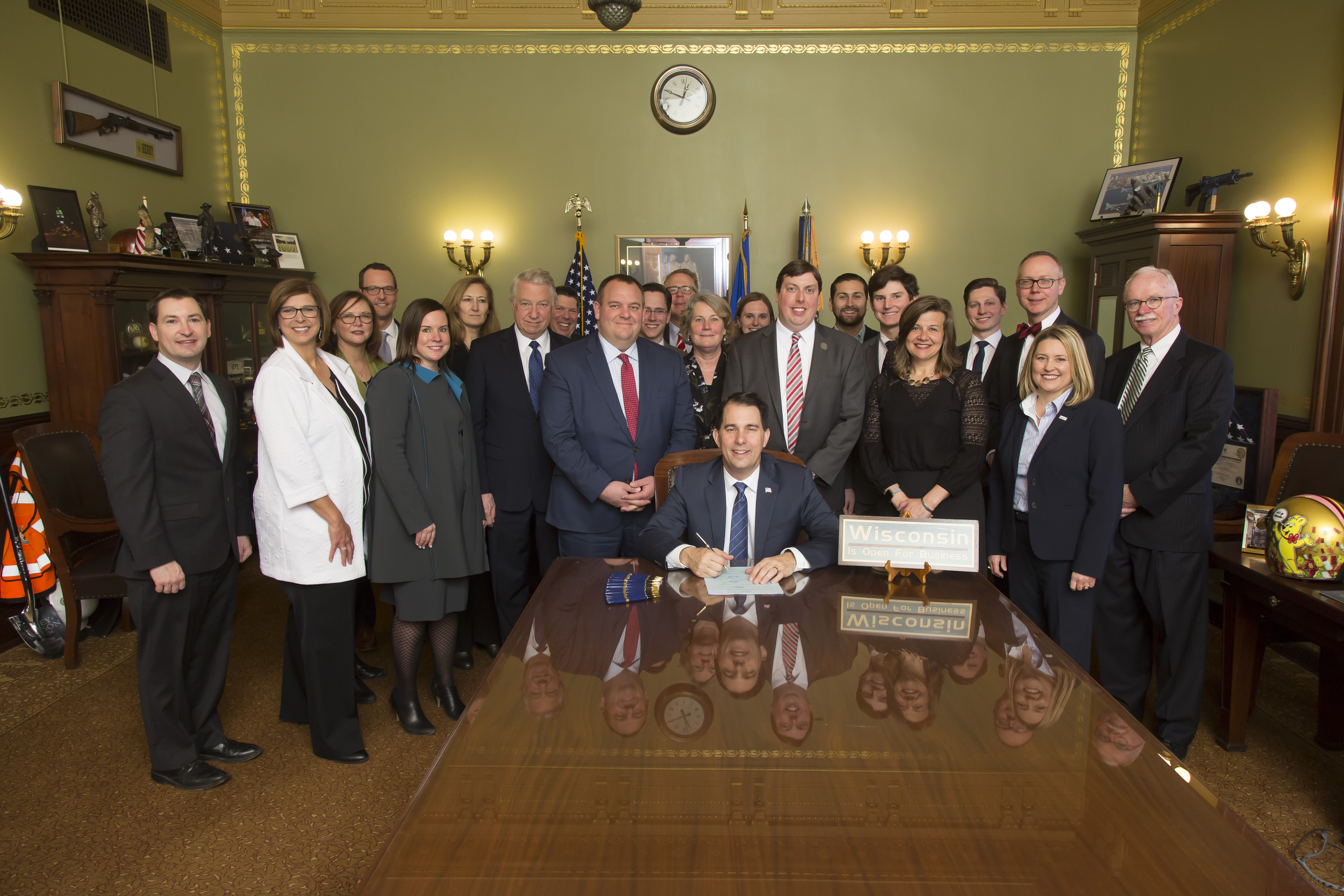
This week, Gov. Scott Walker signed Act 235, which contains a number of important civil litigation reforms, including discovery and class action rules. This major legislation will significantly reduce the cost of litigation for Wisconsin businesses.

Common-sense reforms under Act 235 will:

  • Prevent litigants from abusing the discovery process to leverage a higher potential settlement or engage in a “fishing expedition.”
  • Allow parties to appeal a trial court’s decision to certify a class in a class action lawsuit.
  • Lower the statute of limitations for a number of claims.
  • Prohibit the Department of Revenue from entering into a contract that includes contingency fee audits for any company domiciled in the state or that maintains its principal place of business in the state. Working under contingency fee arrangements incentivizes aggressive approaches to audits that unfairly increase costs for businesses in Wisconsin.
  • Require notice of third-party litigation financing. Such third-party finance can increase the cost of litigation and cause suits to be brought that would not otherwise have been financially justified. Act 235 was recognized by the National Law Journal as being ‘groundbreaking’ legislation, noting that Wisconsin is the first state in the country to pass this provision.

“Act 235 is a major victory for small to large Wisconsin businesses and will greatly reduce the cost of litigation. The legislation brings Wisconsin in line with the vast majority of other states when it comes to its discovery procedures and class action rules. WCJC thanks Gov. Walker and the bill authors, Sens. Tom Tiffany and Dave Craig and Reps. Mark Born and John Nygren,” said Bill G. Smith, president of the Wisconsin Civil Justice Council and state director for National Federation of Independent Business-Wisconsin.

For more information on Act 235, please visit the Wisconsin Civil Justice Council website.