Author: Hamilton

Senate Committee Holds Hearing on Litigation Reform

The Senate Committee on Judiciary and Public Safety held a hearing on Jan. 30 on a bill that would reform Wisconsin’s civil liability statutes to lower litigation costs for Wisconsin businesses and government. SB 645, authored by Sens. Tom Tiffany (R-Hazelhurst) and David Craig (R-Big Bend) and Reps. Mark Born (R-Beaver Dam) and John Nygren (R-Marinette), would further improve Wisconsin’s litigation climate by making changes to discovery and class action statutes, among other reforms.

The bill’s authors began the hearing by emphasizing their goal to draft legislation that makes Wisconsin consistent with federal rules and other states’ procedures and maintains fairness in Wisconsin’s civil justice system.

A wide variety of groups testified in support of the bill. The National Federation of Independent Business, Wisconsin Chapter, and the American Tort Reform Association (ATRA) focused on the costs savings for businesses small and large that could be affected by the debilitating costs of discovery. According to ATRA’s testimony, from 2006 to 2008, the average company paid average discovery costs per case of $600,000 to $3 million. Under the bill’s reforms, they said, businesses will be able to settle based on the merits of the cases, not simply in fear of paying these massive discovery costs.

Wisconsin Manufacturers and Commerce’s (WMC) testimony also emphasized the importance of lowering litigation costs for Wisconsin businesses. WMC highlighted the provision of the bill that prohibits the Department of Revenue (DOR) from hiring third-party audit firms on a contingency fee basis for unclaimed property audits. DOR testified for information only, expressing concerns that this provision could increase costs and make it difficult to hire auditors, but WMC testimony assured legislators that contingency fee arrangement bans have been implemented in other states and would not prohibit audits from taking place in Wisconsin.

The Wisconsin Defense Counsel (WDC) later testified in support of the bill’s provisions regarding discovery and lawsuit lending. The bill’s limit on discovery of electronically stored information would reduce overburdensome discovery requests, and its proportionality requirements would prevent unnecessary “fishing expeditions.” WDC also noted that regulating lawsuit lending makes Wisconsin’s civil liability procedures fairer by protecting consumers and ensuring transparency in civil cases.

The U.S. Chamber of Commerce’s Institute for Legal Reform (ILR) testified on the class action portions of the bill. The bill would make class action statutes more fair and efficient by requiring the type and scope of injury of the representative class members be typical of the type and scope of injury being alleged by the absent class members, thus precluding “no-injury” class actions. The bill also requires class members be verifiable by reliable and feasible means and would provide for interlocutory appeal of class certification. ILR said these changes would make Wisconsin’s civil justice system fairer and less costly.

The Wisconsin Builders Association testified in support of the bill’s provisions related to statute of repose. The revised limits will bring consistency among Wisconsin liability laws and align Wisconsin better with other states that have significantly lower limits. These lower time limits will promote efficiency and reduce burdens and costs on the state and businesses forced to investigate distant claims.

The Wisconsin Insurance Alliance also testified in support of the bill’s provision adjusting the interest rate insurers must pay on overdue claims. The bill provides that the rate mirror interest rates on general judgments and self-adjust consistent with markets.

Wisconsin Economic Development Corporation and the Department of Justice also submitted testimony in support of the bill.

The State Bar of Wisconsin testified for information only, seeking amendments to the bill’s limits on discovery, adjustment of interest rates on overdue claims, changes to statutes of repose, and definition of consumer lawsuit lending.

Those testifying against the bill, including the Wisconsin Association for Justice and the Alliance for Responsible Consumer Legal Funding, arguing that the changes stray too far from simply federalizing Wisconsin statute. Many said that there is no evidence of discovery abuses in Wisconsin and that state judges consistently keep discovery in check. However, supporters refuted that the bill would give judges guidelines related to discovery and class actions that are currently missing from state statute.

The Assembly Committee on Judiciary held a hearing on the bill on Jan. 4. Reps. Ron Tusler (R-Appleton) and Cody Horlacher (R-Mukwonago) have offered an Assembly Substitute Amendment that would remove the class action provisions of the bill.

Committee votes on the bill have not yet been scheduled.
Court of Appeals Decision Allows Temporary Employees to Sue Employers Rather Than File Worker’s Comp Claim

Earlier this year, the Wisconsin Court of Appeals, Dist. III, issued a decision (Ehr v. West Bend Mutual Ins. Co.) that significantly altered the Worker’s Compensation Act. The court ruled that the estate of a deceased employee could sue the employee’s temporary employer for an action in tort instead of filing a worker’s compensation claim under the Act.

Specifically, the court ruled that the “exclusive remedy” provision under the Worker’s Compensation Act, “does not bar a temporary employee from bringing tort claims against his or her temporary employer.”  The decision runs counter to how the Act has been interpreted for many years. The exclusive remedy provision provides that an employee may only receive benefits from worker’s compensation for the injury. By ruling that the exclusive remedy did not apply in this case, the employee was able to sue his employer rather than submit a claim under worker’s compensation.

As a result of the decision Rep. Cindi Duchow (R-Delafield) introduced AB 884, which would effectively reverse the court’s decision. AB 884 prohibits an injured employee from filing an action in tort against third parties regardless of whether the employee makes a claim for compensation under the Worker’s Compensation Act against his or her employer.

The Assembly Committee on Insurance held a public hearing on AB 884 on Feb. 1 and is expected to vote the bill out of committee soon.  The bill is supported by a coalition of business groups, as well as Wisconsin State AFL-CIO.

Assembly Committee Holds Hearing on Litigation Reform Bill

The Assembly Committee on Judiciary held a hearing Thursday on a bill that would reform Wisconsin’s civil liability statutes to lower litigation costs for Wisconsin businesses and government. AB 773, authored by Reps. Mark Born (R-Beaver Dam) and John Nygren (R-Marinette) and Sens. Tom Tiffany (R-Hazelhurst) and David Craig (R-Big Bend), would further improve Wisconsin’s litigation climate by making changes to discovery and class action statutes, among other reforms.

The bill’s authors began the hearing by emphasizing their goal to draft legislation that makes Wisconsin consistent with federal rules and other states’ procedures and maintains fairness in Wisconsin’s civil justice system.

A wide variety of groups testified in support of the bill. The National Federation of Independent Business, Wisconsin Chapter, and the American Tort Reform Association (ATRA) focused on the costs savings for businesses small and large that could be affected by the debilitating costs of discovery. According to ATRA’s testimony, from 2006 to 2008, the average company paid average discovery costs per case of $600,000 to $3 million. Under the bill’s reforms, they said, businesses will be able to settle based on the merits of the cases, not simply in fear of paying these massive discovery costs. Wisconsin Manufacturers and Commerce’s testimony also emphasized the importance of lowering litigation costs for Wisconsin businesses and improving Wisconsin’s litigation climate to help job creation and economic development.

The Wisconsin Defense Counsel (WDC) later testified in support of the bill’s provisions regarding discovery and lawsuit lending. The bill’s limit on discovery of electronically stored information would reduce overburdensome discovery requests, and its proportionality requirements would prevent unnecessary “fishing expeditions.” WDC also noted that regulating lawsuit lending makes Wisconsin’s civil liability procedures fairer by protecting consumers and ensuring transparency in civil cases.

The Wisconsin Civil Justice Council and the U.S. Chamber of Commerce’s Institute for Legal Reform testified on the class action portions of the bill. The bill would make class action statutes more fair and efficient by requiring the type and scope of injury of the representative class members be typical of the type and scope of injury being alleged by the absent class members, thus precluding “no-injury” class actions. The bill also requires class members be verifiable by reliable and feasible means and would provide for interlocutory appeal of class certification. The groups said these changes would make Wisconsin’s civil justice system fairer and less costly.

The Wisconsin Insurance Alliance also testified in support of the bill’s provision adjusting the interest rate insurers must pay on overdue claims. The bill provides that the rate mirror interest rates on general judgments and self-adjust consistent with markets.

The Department of Revenue (DOR) testified for information only on the bill’s provision prohibiting DOR from using contingency fee arrangements with unclaimed property auditors. DOR expressed concerns that this provision could increase costs and make it difficult to hire auditors, but later testimony assured legislators that contingency fee arrangement bans have been implemented in other states and would not prohibit audits from taking place in Wisconsin.

Those testifying against the bill, including the Wisconsin Association for Justice and the Alliance for Responsible Consumer Legal Funding, argued that the changes stray too far from simply federalizing Wisconsin statute. Many said that there is no evidence of discovery abuses in Wisconsin and that state judges consistently keep discovery in check. However, supporters refuted that the bill would give judges guidelines related to discovery and class actions that are currently missing from state statute.

AB 773 has 23 sponsors in the Assembly and five in the Senate. So far 17 groups have registered in support.

The Senate version of the bill has been referred to the Committee on Judiciary and Public Safety, and no public hearing has been scheduled.


Litigation Reform Legislation Circulated

This week, Reps. Mark Born (R-Beaver Dam) and John Nygren (R-Marinette) and Sens. Tom Tiffany (R-Hazelhurst) and David Craig (R-Big Bend) circulated litigation reform legislation (LRB 4700) aimed at lowering costs for Wisconsin businesses and government. The bill would modernize Wisconsin’s civil procedures for discovery and class actions to align with corresponding federal rules.

The bill’s reforms address the escalating transactional costs relating to discovery by:

  • Making it clear that both courts and parties have an obligation to pursue the just, speedy, and inexpensive resolution of each case.
  • Establishing cost-benefit and proportionality requirements for discovery to prevent litigants from abusing the discovery process to leverage a higher potential settlement or engage in a “fishing expedition.”
  • Putting on hold discovery and other proceedings pending the court’s decision on a motion to dismiss or other dispositive motions, protecting parties from costly discovery in cases that may be dismissed or where refinement of the pleadings may clarify the allegations and scope of relevant discovery.
  • Providing notice of third-party litigation financing, if the financier has a right to receive compensation that is contingent on and sourced from the outcome of the action. Such third party finance can increase the cost of litigation and cause suits to be brought that would not otherwise have been financially justified.
  • Limiting discovery of electronically stored information (ESI) to address the escalating volume of ESI that is now one of the most significant discovery-related costs.
  • Unless otherwise stipulated or ordered by the court, limiting discovery to 25 interrogatories, 10 depositions, none of which may exceed 7 hours in duration, and a look-back period of not more than 5 years prior to the accrual of the cause of action.

Other reforms related to class action litigation include:

  • Aligning Wisconsin’s class action statute with Federal Rule 23. This will provide needed specificity, clarity, and consistency not found under Wisconsin’s current law. Wisconsin’s current one-sentence class action statute is essentially identical to the 1849 Field Code. After 168 years, it’s time for an upgrade. We would be the 48th state to do so.
  • Providing a nondiscretionary right to an interlocutory appeal of class certification orders by both plaintiffs and defendants. This is a vital ruling that makes or breaks the case. It should be appealable before other aspects of the case proceed.
  • Precluding “no-injury” class actions by requiring the type and scope of injury of the representative parties be typical of the type and scope of injuries of the class.
  • Requiring that the class of consumers eligible to make a claim be “ascertainable” by requiring the members of the class be objectively verifiable by reliable and feasible means.

Other reforms in the bill include:

  • Regulating lawsuit lending that provides money to consumers with repayment of the money derived from the consumer’s proceeds from the dispute (e.g., a judgment or settlement). There are times when reasonable settlement amounts that would otherwise be agreed upon between plaintiff and defense counsel are rejected because the injured party is “under water” to lawsuit lenders. The regulation of the industry will protect vulnerable Wisconsin consumers from lawsuit lenders that sometimes prey on those injured and unable to work or who may otherwise have substantial medical bills.
  • Resetting statute of limitations – the maximum period that one can wait before filing a lawsuit – for certain civil litigation. The revised limits will bring consistency among Wisconsin liability laws and align us better with other states that have significantly lower limits. These lower time limits will promote efficiency and reduce burdens and costs on the state and businesses forced to investigate distant claims.
  • Prohibiting the Department of Revenue from entering into a contingent fee agreement with third parties to engage in an audit relating to Wisconsin’s unclaimed property law. State unclaimed property laws, when fairly and appropriately enforced, serve several important functions. But private auditors working under contingency fee arrangements have taken an increasingly aggressive approach to the interpretation and enforcement of unclaimed property laws, which in turn, increases the costs of doing business in Wisconsin.
  • Adjusting the interest rate insurers must pay on overdue claims from 12 percent to the prime loan rate plus one percent. In doing so, this rate will mirror interest rates on general judgments and allow the rates to self-adjust consistent with markets.

The bill is supported by Wisconsin Attorney General Brad Schimel, Wisconsin Civil Justice Council, Wisconsin Manufacturers and Commerce, American Tort Reform Association, and the U.S. Chamber of Commerce’s Institute for Legal Reform, among other organizations. Cosponsorship for the bill is due Wednesday, Dec. 6.

See related coverage from MacIver Institute.

Assembly Holds Hearing on Bill Putting Expiration Dates on Rules

With respect to regulatory reform, the governor’s small business agenda includes legislation that would sunset all regulations every seven years. He was referencing AB 384/SB 295, authored by Sen. Alberta Darling (R-River Hills) and Rep. Jim Steineke (R-Kaukauna).

On Sept. 19, the Assembly Committee on Regulatory Licensing Reform held a hearing on AB 384. Among other business groups supporting the legislation, WMC’s testimony noted that “once a regulation is promulgated it stays in the books indefinitely.” The bill creates an expedited process for rule promulgation and legislative review, for existing and new regulations.

The bill requires that the legislature set a seven-year schedule to review every existing regulatory code chapter. Only if the legislature requests “re-adoption” would the existing rule be required to be promulgated again or face expiration. Such a review presents a daunting challenge for the legislature and agencies. For example, the Department of Natural Resources (DNR) alone has 385 individual code chapters, consisting of over 4,500 pages. There are 76 departments, commissions, and boards in Wisconsin with regulations contained in Wisconsin’s Administrative Code.

Lawsuit and Regulatory Reform on Gov. Walker’s Small Business Agenda

On Sept. 26, Gov. Walker set forth his small business agenda while hosting the seventh annual Small Business Summit. His plan to improve Wisconsin’s business climate includes lawsuit and regulatory reform.

At the summit, the governor renewed his commitment “to enact lawsuit reforms to protect small businesses.” According to the National Federation of Independent Businesses, a typical small business is six times more likely to be sued than to sue.

The Wisconsin Civil Justice Council (WCJC) hailed the renewed commitment to litigation reform, with WCJC President Billy G. Smith noting “the easiest way to lower litigation costs for everyone, including large and small businesses, state and local governments, plaintiffs and defendants, is to address the escalating transaction costs associated with discovery.”

A recent study found that most of the documents retrieved in discovery are never submitted as evidence. In 2008, for example, of the close to 5 million pages of documents produced in discovery in major cases that went to trial, only 4,772 exhibit pages were marked. That means over 99.9 percent of those documents retrieved were never used. “That is an incredible waste of time and money,” according to Smith.

Supreme Court and Governor Eliminate Funding for Judicial Council

Earlier this year, the Supreme Court sent an order to the Department of Administration (DOA) that it will no longer transfer funds to DOA in support of the Judicial Council. Separately, Gov. Scott Walker defunded the Council through a veto in the state budget.

The Supreme Court cited concerns about an “extraordinary” 38 percent salary increase for the Judicial Council staff attorney effective July 1 and the “means and manner” by which the increase was obtained. Justices Ann Walsh Bradley and Shirley Abrahamson dissented, arguing for the Judicial Council’s importance to Wisconsin’s judicial system.

The Judicial Council’s four-person executive committee met in June and voted to raise the Council’s only staff attorney April Southwick’s salary from $59,600 to $82,326. The Wisconsin State Journal reported that on August 1, Director of State Courts Randy Koshnick sent an email to DOA saying that under state law, the executive committee could not authorize a raise without a quorum of 11 council members. According to the Wisconsin State Journal article, in a later email to the Associated Press, Southwick said the raise was meant to increase her salary to the level of “a male judicial branch employee in a similar position.”

After the Supreme Court sent the order to DOA, Gov. Scott Walker issued a veto of provisions relating to the Judicial Council in the state budget. Walker had originally proposed eliminating the Judicial Council, but the Joint Finance Committee and the budget bill as passed by the legislature restored the Council. Walker’s veto did not eliminate the Council, but eliminated funding for the Council. The statute (20.670) creating the Judicial Council remains in place.

Bills of Note: Device Use While Driving

Last week, the Assembly Committee on Criminal Justice and Public Safety held a public hearing on a bill that would prohibit using electronic devices while driving. The bill expands existing state law prohibiting texting and emailing while driving to include entering, transmitting, or accessing data via an “interactive electronic device.” These infractions would be categorized under “inattentive driving.” Exceptions to device usage include device use for reporting an emergency, verbal communication, navigation, and electronics integrated into the vehicle.

The committee hearing on the bill (AB 463/SB 380), authored by Rep. Ron Tusler (R-Harrison) and Sen. Van Wanggaard (R-Racine), took place on Sept. 21. At the hearing, Tusler said the bill’s expansion of distracted driving prohibitions and increased penalties would discourage the dangerous practice of cell phone use while driving and clarify that texting is considered negligent driving. Tusler said the exceptions give the bill some flexibility and mentioned the possibility of adding another exception for the use of electronic devices for medical needs.

Also testifying in favor of the bill was Rep. Shannon Zimmerman (R-River Falls), Wisconsin Association for Justice, Milwaukee Police Association, Wisconsin State Fire Chiefs Association, and Wisconsin Bicycle Federation. Also registered in favor of the bill are Wisconsin Chiefs of Police Association and Wisconsin EMS Association.

Throughout the hearing, lawmakers questioned the scope of the bill, asking, for example, whether the bill would apply to law enforcement, what would happen if a Bluetooth device stopped working mid-call, and if leaving apps open on your phone would count as “transmitting data.”

No groups testified against the bill, but Bob Fassbender testified on behalf of Wisconsin Civil Justice Council (WCJC) for information only. Fassbender agreed that the current law is too narrow to address the wide range of distractive driving while engaging electronic devices. But as drafted, according to Fassbender, the bill is overly broad and will create unintended and mostly unavoidable violations because too many non-exempt devices will be transmitting or accessing data while driving. Also, these violations will trigger the legal concept of negligence per se, making any defense an uphill battle at best.

Wisconsin Civil Justice Council Files Amicus Brief in Mayo Case

Last week, the Wisconsin Civil Justice Council (WCJC) filed an amicus brief with the Supreme Court of Wisconsin in Ascaris Mayo v. Wis. Injured Patients and Families Compensation Fund. WCJC supports the patients’ compensation fund position on the validity of the $750,000 cap on noneconomic damages arising out of medical malpractice claims. The brief asked that the court grant the fund’s request for review.

In a July 5 opinion, the Wisconsin Court of Appeals, District 1 (Milwaukee County), found the statutory $750,000 cap unconstitutional. The court found the cap was “an unfair and illogical burden only on catastrophically injured patients, thus denying them equal protection of the law.”

The WCJC brief sets forth the parties’ interest in the case, focusing on the appropriate standard for courts considering reversal of legislative enactments. Since Ferdon v. Wis. Patient Comp. Fund, the courts have been unclear regarding the “rational basis” test as it relates to an equal protection claim. WCJC’s brief asks the Supreme Court to draw a clear line to make damages more predictable.

The case arose from a septic infection resulting in the amputation of the plaintiff’s limbs. The lower court did not find negligence, but instead rested liability on improper informed consent regarding diagnosis and treatment options. The jury awarded the plaintiff $15 million in noneconomic damages, such as pain and suffering, and $1.5 million to the plaintiff’s husband for loss of society and companionship. Unaffected is the reported $8.8 million award for economic damages, which has no statutory limitation.

Joining WCJC on the brief was the American Tort Reform Association and the National Federation of Independent Businesses.

State Files Opening Brief in SCOTUS Redistricting Case

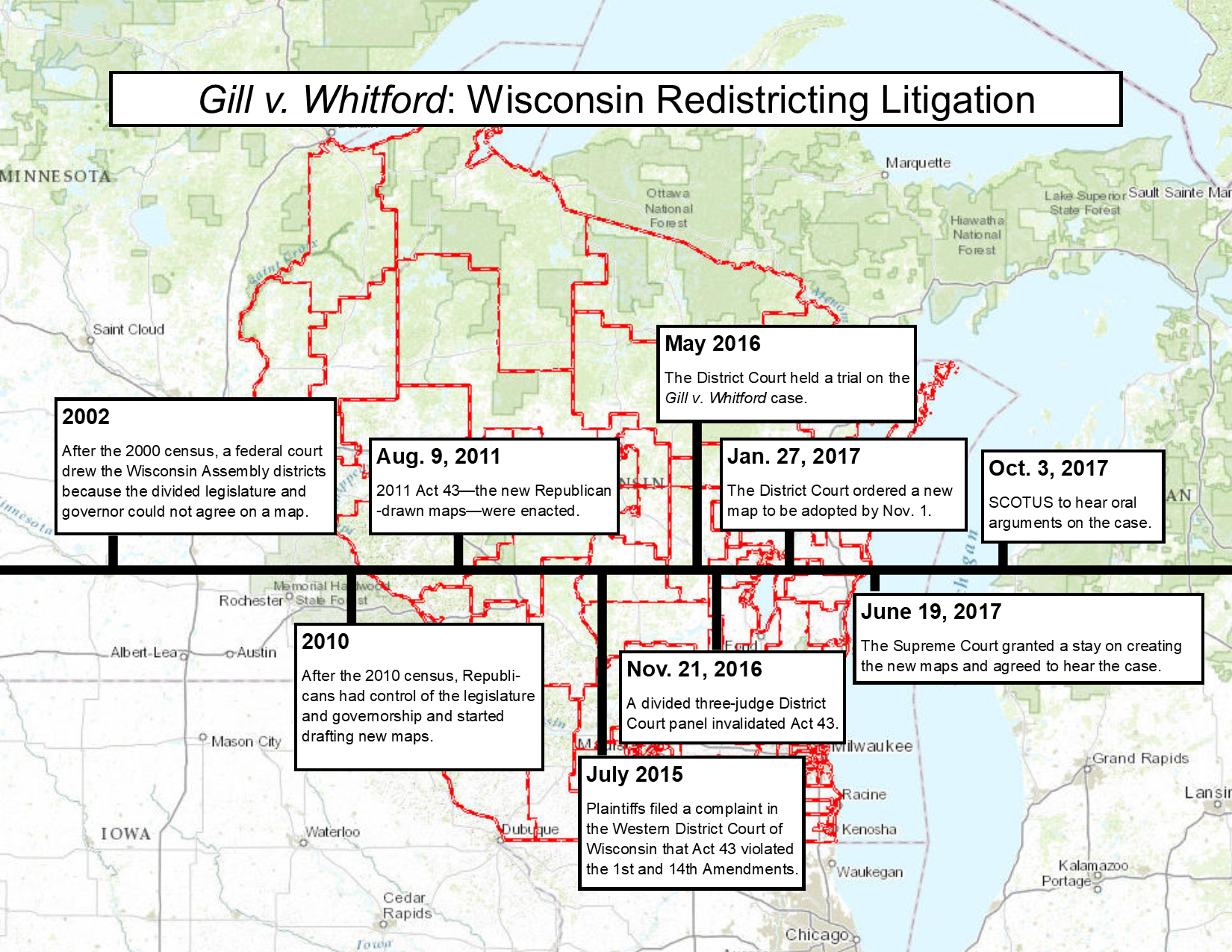
Last week, Attorney General Brad Schimel filed with the U.S. Supreme Court the opening brief in Gill v. Whitford, the legal challenge to Wisconsin Republicans’ redistricting map brought by Democratic voters against officials of the Wisconsin Elections Commission.

In the brief, Schimel argues that the Supreme Court should dismiss the district court decision because the maps the district court struck down comply with traditional redistricting principles and do not differ from the previous 2002 court-drawn map in terms of election outcomes.

The brief further argues that federal courts have no jurisdiction to adjudicate statewide political gerrymandering claims, and the plaintiffs lack standing to challenge the district maps on a statewide basis. Even if standing was established, the plaintiffs did not provide a “limited” and “precise” means for the courts to determine partisan gerrymandering, according to the defendants’ brief.

The Supreme Court announced on June 19 that it would review Gill v. Whitford. By 5-4 vote, the Supreme Court also granted Attorney General Brad Schimel’s request to stay the lower court’s order requiring a timely redrawing of the Assembly district map. The Supreme Court will hear oral arguments for the case on October 3, 2017.